Our Methodology & Transparency Disclosure
What is FuturePlus?
Powered by data and guided by human expertise, FuturePlus is a sustainability management and reporting platform that helps organisations and investors understand, measure, improve and communicate their social and environmental impact.
Through a structured, evidence-based framework aligned with recognised standards, FuturePlus enables organisations to establish a clear sustainability baseline, identify opportunities for improvement, and demonstrate credible progress over time. Our approach turns complex sustainability requirements into practical actions that strengthen resilience, build trust with stakeholders and create long-term value.
We believe businesses make better decisions when they can clearly understand their impact and measure meaningful progress. By combining robust data, independent evidence verification and practical guidance, FuturePlus helps organisations embed sustainability into the way they operate, rather than treating it as a standalone reporting exercise.
What Sets FuturePlus Apart?
FuturePlus is designed as a sustainability management and continuous improvement platform, helping organisations understand where they are today, identify opportunities for improvement, and measure progress over time.
Rather than producing a simple certification outcome, FuturePlus provides a detailed, evidence-based assessment across five core themes, resulting in a score out of 500 that establishes an organisation’s sustainability baseline. This enables businesses to understand both their current performance and the areas where they can have the greatest impact.
The assessment is underpinned by rigorous evidence verification. Each piece of evidence submitted against an indicator is reviewed and verified against defined criteria. Evidence either meets the required standard or it does not, ensuring consistency and integrity across all assessments. It is this evidence verification that operates on a pass/fail basis, not the overall assessment itself.
We recognise that meaningful sustainability improvement is a journey rather than a fixed destination. By using an intelligent, dynamic question set that scales according to an organisation’s size, sector and geography, FuturePlus helps businesses build strong sustainability foundations, set realistic ambitions, and transparently track progress over time.

Methodology Principles
The FuturePlus methodology is built around core principles that guide the design, development and ongoing evolution of the framework.
Evidence Before Claims
FuturePlus measures sustainability using verified evidence rather than self-declared commitments or marketing statements. Every Actual Score is based on information that has been reviewed against defined evidence standards, providing confidence that reported performance reflects demonstrated practice.
Continuous Improvement
Sustainability is not a fixed destination. The FuturePlus methodology is designed to establish an organisation’s current baseline, identify opportunities for improvement and measure progress over time. The framework recognises organisations at different stages of maturity and encourages continual development.
Independent and Transparent
FuturePlus is committed to maintaining a transparent and robust methodology. The framework is reviewed periodically to reflect changes in legislation, recognised standards, emerging sustainability topics and industry best practice.
The development of the methodology is informed by ongoing engagement with sustainability practitioners, subject matter experts, clients and industry stakeholders. Where appropriate, FuturePlus seeks external expert input to challenge and strengthen the framework as it evolves.
FuturePlus publishes its methodology, maintains documented evidence requirements, and operates formal verification, appeals and grievance procedures to promote consistency, transparency and trust.
Proportionate and Material
FuturePlus is designed to be applicable to organisations of different sizes, sectors and operating models. The assessment uses a dynamic indicator framework that expands or contracts based on factors such as organisation size, sector and activities, ensuring organisations are assessed against the indicators that are relevant to their operations.
While the number and type of applicable indicators may vary, the underlying methodology, scoring approach and indicator weightings remain consistent across all assessments. This ensures organisations are assessed fairly while maintaining meaningful comparison across the FuturePlus framework.
Comparable and Consistent
All organisations are assessed using the same underlying methodology, enabling meaningful comparison across sectors, organisation sizes and geographies. While the dynamic question set adapts to ensure relevance, the scoring methodology remains consistent, allowing results to be benchmarked fairly.
Living Methodology
Sustainability expectations continue to evolve. The FuturePlus methodology is therefore reviewed periodically to reflect changes in legislation, international standards, emerging sustainability issues and industry best practice. Indicators may be added, amended or removed where this improves the quality, relevance and integrity of the assessment, while maintaining a consistent scoring methodology.
Management, Not Reporting
FuturePlus is designed to help organisations manage sustainability, not simply report on it. The framework provides the structure, measurement and guidance needed to embed sustainability into decision-making, operations and governance, enabling organisations to improve performance as well as communicate it.

Five Themes to Measure Your Impact

CLIMATE

DIVERSITY & INCLUSION

SOCIAL

ECONOMIC

ENVIRONMENT
Together, these themes provide a balanced assessment of an organisation’s sustainability performance, recognising that meaningful impact extends beyond environmental considerations alone.
Each theme is assessed through a common set of cross-cutting assessment dimensions, including Governance, Leadership, Workforce, Supply Chain, Ecosystem, Carbon Footprint, Manufacturing & Industry and Global Goals.
These dimensions or subcategories are intentionally integrated throughout the framework rather than treated as standalone sections. For example, governance is assessed across every theme, recognising that effective governance influences climate strategy, environmental management, workforce practices, ethical business conduct and diversity and inclusion. Likewise, supply chain, leadership and workforce considerations are evaluated wherever they materially contribute to sustainability performance.
This integrated approach provides a more complete picture of organisational sustainability than assessing each topic in isolation.
The indicator set spans a broad range of sustainability topics to enable consistent benchmarking across organisations of different sizes and sectors. While some indicators will naturally be more material to certain organisations than others, the weighted scoring methodology ensures that assessments remain fair, balanced and comparable while reflecting the relative significance of each indicator.
Human rights, labour standards, ethical business conduct and responsible supply chain management are embedded throughout the framework rather than confined to a single theme. This reflects the reality that these issues influence multiple aspects of organisational sustainability and should be assessed holistically rather than in isolation.
Scoring Methodology (Actual & Ambition)
FuturePlus uses a dual-score methodology to distinguish between an organisation’s verified sustainability performance today and its commitment to future improvement.
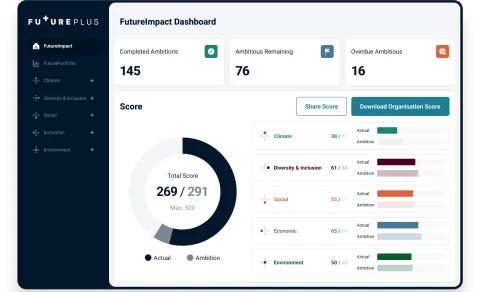
ACTUAL SCORE: Current Performance
The Actual Score measures an organisation’s current sustainability performance based solely on verified evidence submitted during the assessment process. It reflects what has been implemented and demonstrated at the time of assessment and is not influenced by future intentions or commitments.
Evidence submitted for each indicator is independently reviewed by FuturePlus against defined verification criteria. Evidence either satisfies the requirements for that indicator or it does not. This verification process ensures that Actual Scores are based on demonstrable, substantiated performance rather than self-declaration.
ACTUAL SCORE: Current Performance
The Ambition Score recognises an organisation’s commitment to future improvement. It allows organisations to set measurable, time-bound sustainability objectives across the FuturePlus framework, typically within a timeframe of three months to three years.
These ambitions form the basis of the organisation’s Sustainability Roadmap, providing a structured programme of improvement that can be monitored, updated and reviewed over time. Ambition commitments do not contribute to the Actual Score until they have been implemented and supported by verified evidence.
Weighted Scoring
The FuturePlus assessment produces both an Actual and Ambition overall score out of 500, with each of the five themes contributing up to 100 points.
Indicators are weighted according to their significance within the methodology, recognising that some sustainability practices have greater influence on organisational performance than others. Depending on the response provided, an indicator may have a positive, neutral or negative impact on the overall score.
Although organisations may answer different combinations of indicators through the dynamic assessment framework, scores are normalised within the same methodology to ensure fair and meaningful comparison across organisations of different sizes, sectors and geographic locations.
Data Collection & Evidence Verification
FuturePlus assessments are based on information provided directly by participating organisations. Unlike methodologies that rely on publicly available information or automated data collection, FuturePlus requires organisations to actively demonstrate their sustainability performance through the submission of supporting evidence.
Evidence may include policies, reports, procedures, management records, operational data, certifications and other documentation appropriate to the indicator being assessed.
Every submission undergoes verification by a trained FuturePlus employee against defined evidence standards. Evidence is assessed for its relevance, authenticity, completeness and currency before being accepted within the assessment.
To maintain objectivity, FuturePlus operates a checker-reviewer model, separating client support from evidence verification wherever practical. This ensures that organisations receive guidance throughout the assessment process while maintaining the independence of verification decisions.
To reduce administrative effort, organisations may choose to use FuturePlus AI Smart Intake to pre-populate assessment responses using existing documentation. AI-generated responses are provided solely as drafting assistance. All responses remain subject to the same human verification process and organisations remain responsible for confirming the accuracy of all submitted information.
Assessments remain dynamic throughout membership. Organisations may update evidence as improvements are made, allowing their Actual Score to evolve alongside their sustainability performance.
Custom Indicators
While the FuturePlus methodology provides a comprehensive core framework applicable across sectors, organisations may also choose to create Custom Indicators to reflect their own strategic priorities, stakeholder requirements or industry-specific objectives.
Custom Indicators allow organisations to monitor additional sustainability metrics alongside the standard FuturePlus assessment while benefiting from the same platform functionality, advisory support and roadmap management.
To preserve the integrity and comparability of the FuturePlus methodology, Custom Indicators do not contribute to an organisation’s Actual Score, Ambition Score or Impact Certified status. They exist solely to enable organisations to monitor additional objectives beyond the core FuturePlus framework.
IMPACT CERTIFIED Badge
FuturePlus IMPACT CERTIFIED recognises organisations that have completed a verified FuturePlus assessment and demonstrated their sustainability performance through independently reviewed evidence.
Certification reflects an organisation’s verified Actual Score at a specific point in time and is awarded using the FuturePlus certification levels. The certification is intended to communicate an organisation’s current sustainability performance rather than future aspirations.
Certified organisations receive permission to display the FuturePlus IMPACT CERTIFIED badge and associated communication assets, including the FuturePlus QR Code, in accordance with the FuturePlus Brand and Communications Guidelines.
Where organisations make public sustainability claims using their certification, they remain responsible for ensuring those claims comply with all applicable legislation and accurately reflect their verified performance. FuturePlus reserves the right to suspend or withdraw certification where organisations misuse certification, provide misleading information or fail to maintain the standards required under the methodology.
Where independent third-party verification is required by legislation, customer requirements or requested by the organisation, FuturePlus may facilitate additional external assurance through an appropriately qualified independent verification body.

Portfolio Management
FuturePlus enables investors, procurement teams, supply chain managers and portfolio managers to assess sustainability performance consistently across multiple organisations.
The Portfolio Dashboard aggregates verified FuturePlus assessments to provide portfolio-level insight while retaining visibility of each participating organisation’s individual performance. This enables organisations to identify strengths, risks and opportunities for improvement across portfolios, investment funds and supply chains.
Because all participating organisations are assessed using the same underlying methodology, portfolio reporting provides a consistent basis for benchmarking, engagement and ongoing performance monitoring, while recognising the different sectors, sizes and operating contexts of individual organisations.
Governance, Appeals & Continuous Improvement
The FuturePlus methodology is governed through a methodology review process to ensure it remains relevant, transparent and aligned with emerging sustainability standards, legislation and best practice.
The methodology is periodically reviewed, with oversight and input from the independent Advisors. Updates may include the addition, amendment or removal of indicators where necessary to improve the quality, relevance or robustness of the framework.
FuturePlus maintains formal procedures for appeals, complaints and grievances.
Organisations may challenge verification decisions, while employees, customers and other stakeholders may raise concerns through the FuturePlus Grievance Procedure where they believe an assessment or certification does not accurately reflect an organisation’s performance.
Where evidence is found to have been intentionally misrepresented, or where organisations fail to comply with the requirements of the methodology or certification programme, FuturePlus may require corrective action, suspend certification or withdraw certification entirely.
A version history of the methodology is maintained to provide transparency over significant updates to the framework and to support consistent application across all assessments.
WE TURN ESG INTO
COMPETITIVE ADVANTAGE

300+ COMPANIES ARE WITH US, ARE YOU?